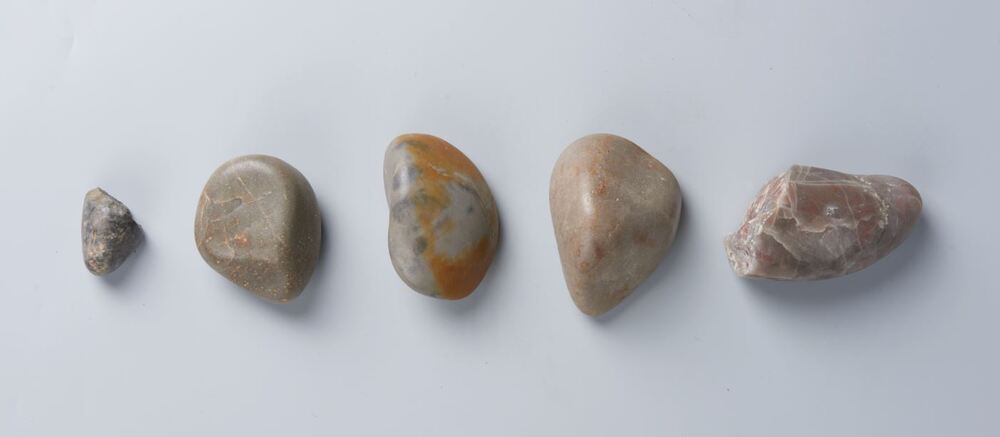
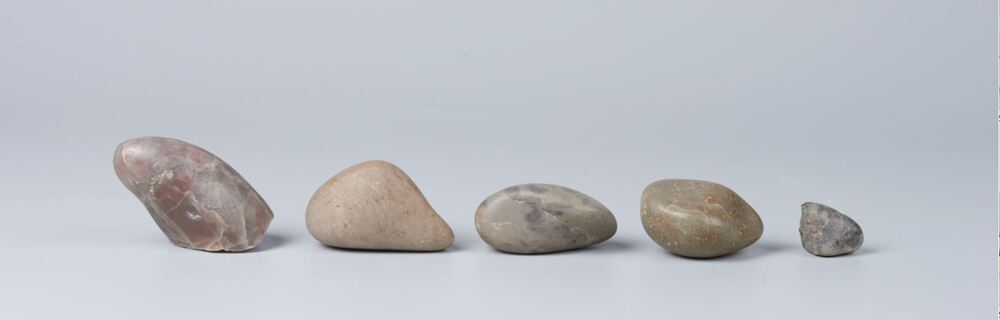
Five gastroliths (stomach stones) from dinosaurs
Where found: Utrillas Formatie, surroundings of Montoro de Mezquita, Teruel province, Spain
Collection: Paleontology
These look like ordinary stones, but they are not. The noticeable shine of the stones indicates that they have a special history. The stones functioned as gastroliths (stomach stones) in the stomachs of dinosaurs. The dinosaurs swallowed the stones to grind the food in their stomachs, as crocodiles and some birds, including ostriches, still do. All the stones are Armorican quartzite, a hard metamorphic rock that is highly resistant to erosion and weathering, and also did not dissolve in the acidic stomachs of the dinosaurs. The strong shine of the stones results from years of friction with (presumably vegetable) food and other stones in the stomach.
We do not know which dinosaurs used these stones, as they were found completely isolated in fine sandstone, with no other dinosaur remains. Based on the age of the sandstones, we do know that dinosaurs lived some 120 million years ago, during the Early Cretaceous period. Some stones may have come back out via faeces, but it is plausible that the highly polished stones remained inside the dinosaur its whole life, only being released when the dinosaur died and its carcass was torn apart by scavengers.
Three stomach stones are complete and are shiny on all sides. Two of the specimens are no longer intact after being used as gastrolite.